
eine Nachricht hinterlassen
Wenn Sie an unseren Produkten interessiert sind und mehr Details erfahren möchten, hinterlassen Sie bitte hier eine Nachricht. Wir werden Ihnen so schnell wie möglich antworten.


Fiber access networks use several types of passive equipment to protect, organize, connect, and distribute optical fibers. Among the most commonly confused products are the fiber distribution cabinet, fiber optic splice closure, and fiber termination box.
Although all three products are used in FTTH, FTTB, FTTx, telecom, broadband, and enterprise fiber networks, they perform different jobs and are normally installed at different points in the network.
Choosing the wrong enclosure can create unnecessary installation costs, reduce maintenance efficiency, or leave the network without enough capacity for future expansion. For example, using a small termination box where a distribution cabinet is required may create port shortages. On the other hand, installing a large cabinet for a simple splice point can significantly increase project cost.
This guide explains the technical differences between these three products and helps network operators, contractors, distributors, and project buyers select the right solution.
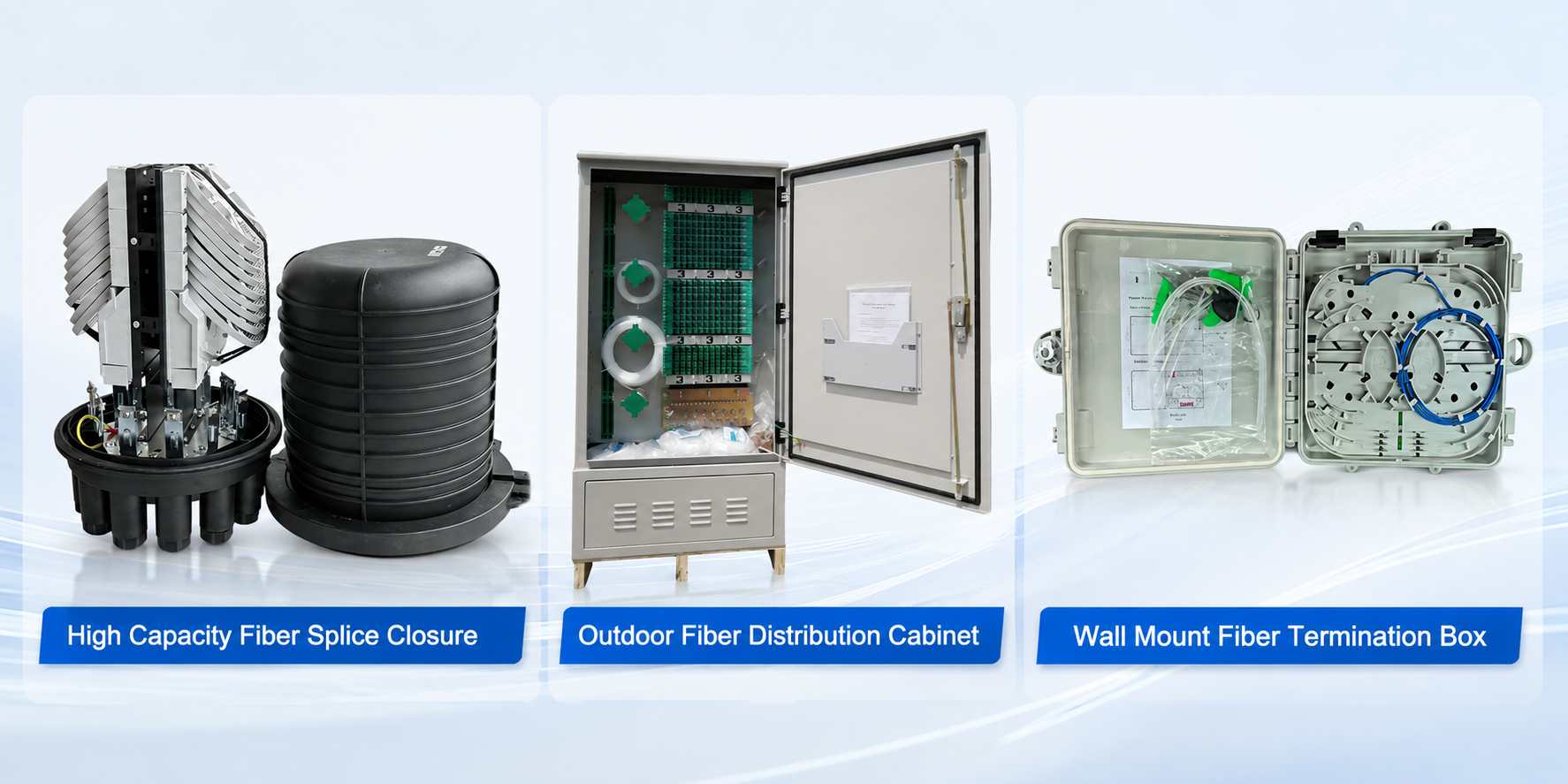
| Product | Main Function | Typical Installation Area | Typical Capacity | Access Frequency |
|---|---|---|---|---|
| Fiber Distribution Cabinet | Fiber distribution, cross-connection, splitting and management | Outdoor network nodes, telecom access points | 48–288+ fibers, depending on design | Medium to high |
| Fiber Optic Splice Closure | Protect and organize permanent fiber splices | Aerial, underground, duct or outdoor networks | 12–288+ fibers, depending on splice trays | Low |
| Fiber Termination Box | Terminate and connect optical fibers to end users or equipment | Indoor walls, buildings, telecom rooms or access points | 1–24 ports commonly used | Medium |
The easiest way to understand the difference is to look at the fiber path.
Backbone Fiber → Splice Point → Distribution Node → Drop Fiber → End User or Equipment
A splice closure is mainly responsible for protecting the splice point. A distribution cabinet manages larger fiber groups and distributes connections to different network branches. A termination box is generally closer to the final user, building, floor, or equipment connection point.
A fiber distribution cabinet is designed for centralized fiber management and distribution. It is normally installed where feeder cables, distribution cables, splitters, adapters, pigtails, and patch connections need to be organized within one enclosure.
An Outdoor Fiber Distribution Cabinet is commonly used in FTTH and FTTx projects where a larger number of subscriber connections must be managed from a central outdoor location. Depending on the project design, the cabinet may include splice trays, PLC splitters, adapter panels, patching areas, and cable management systems.
The cabinet acts as a transition point between different sections of the optical network. For example:
| Network Side | Typical Function |
|---|---|
| Incoming Feeder Cable | Connects the cabinet to the central office or upstream network |
| Splicing Area | Joins incoming and outgoing fibers when permanent connections are required |
| PLC Splitter Area | Splits one optical signal into multiple subscriber paths |
| Distribution Area | Routes fibers to multiple drop cables or downstream network points |
| Adapter/Patch Area | Allows organized connector access, testing and network reconfiguration |
For large access networks, cabinet capacity should not be selected based only on current subscriber numbers. Network expansion, spare ports, splitter configuration, cable entry space, and maintenance access should also be considered.
For example, a project serving 48 active connections may require more than 48 physical positions if spare fibers, future customers, redundant paths, or splitter modules must be accommodated.
A fiber optic splice closure is primarily designed to protect fiber splices from moisture, dust, mechanical stress, temperature changes, and other environmental conditions.
Unlike a distribution cabinet, a closure is not primarily designed for frequent patching or daily connection changes. Its main job is to provide a protected environment for permanent or semi-permanent fiber connections.
A High Capacity Fiber Splice Closure is particularly useful when multiple feeder or distribution cables must be spliced within the same outdoor network section. Depending on the tray configuration and fiber type, large closures can support dozens or even hundreds of splice positions.
Common installation methods include:
Environmental protection is one of the most important selection factors. Outdoor closures may be designed for IP65, IP67, or IP68 performance depending on the product and project requirements. However, buyers should not simply select the highest IP rating without reviewing the actual installation environment, cable entry design, sealing method, reopening requirements, and test standards.
For demanding outdoor applications, some commercial fiber closures are designed for IP68 protection and operating temperature ranges such as -40°C to +65°C. Actual requirements should always be confirmed against the project specification and the supplier's test documentation.
A fiber termination box is generally used closer to the end of the optical network. Its main purpose is to terminate incoming optical cables and provide an organized connection point for equipment, patch cords, adapters, or subscriber drop fibers.
A Wall Mount Fiber Termination Box is commonly installed in offices, apartment buildings, telecom rooms, corridors, equipment rooms, and FTTH access points. It is usually smaller than a distribution cabinet and easier to install where space is limited.
The internal configuration may include:
Termination boxes are suitable when the main requirement is to create a clean and protected handoff point rather than manage a large distribution network.
| Application | Recommended Product | Reason |
|---|---|---|
| Apartment or office fiber handoff | Fiber Termination Box | Compact termination and connector management |
| Building distribution point | Distribution Cabinet or Distribution Box | Supports multiple outgoing connections |
| Underground cable splice | Fiber Optic Splice Closure | Protects permanent fiber joints |
| Outdoor FTTH distribution node | Outdoor Fiber Distribution Cabinet | Supports distribution, splitting and future expansion |
| Large backbone branching point | High Capacity Fiber Splice Closure | Provides protected high-density splice management |
| Telecom room or equipment connection | Wall Mount Fiber Termination Box | Provides organized termination in limited space |
Many buyers start by asking, “How many fibers does the enclosure support?” Capacity is important, but it should not be the only selection criterion.
A proper procurement review should include at least the following factors:
| Selection Factor | Questions to Ask |
|---|---|
| Fiber Count | How many fibers are required now, and how many may be required later? |
| Installation Environment | Indoor, outdoor, aerial, underground or duct? |
| Protection Level | What IP rating and environmental resistance are required? |
| Splicing Requirement | How many fusion or mechanical splices are required? |
| Splitter Configuration | Will PLC splitters be installed inside the enclosure? |
| Connector Type | SC, LC, FC or another interface? |
| Cable Diameter | Can the cable entry system support the required cable size? |
| Maintenance Access | Will technicians need frequent access for testing or reconfiguration? |
| Expansion Space | Are spare ports, trays and cable entries available? |
For long-term network projects, leaving approximately 15%–30% additional capacity can be a practical planning approach, depending on the expected subscriber growth and network design. This is not a fixed industry requirement, but it can help reduce the cost of replacing equipment when the network expands.
| Your Main Requirement | Best Choice | Why |
|---|---|---|
| Protect a cable splice in an underground network | Fiber Optic Splice Closure | Designed for sealed splice protection |
| Manage feeder and distribution fibers for multiple users | Fiber Distribution Cabinet | Provides higher capacity and organized distribution |
| Terminate fiber inside a building | Fiber Termination Box | Compact and suitable for equipment or subscriber connections |
| Install splitters and distribute multiple drop cables outdoors | Outdoor Fiber Distribution Cabinet | Supports centralized fiber distribution |
| Handle a large number of protected splice connections | High Capacity Fiber Splice Closure | Supports multi-tray splice management |
| Create a compact fiber handoff point | Wall Mount Fiber Termination Box | Efficient for indoor walls and limited installation space |
In a typical optical access network, these products are not necessarily alternatives. In many projects, all three may be used at different stages.
A simplified example may look like this:
Central Office / ODF → Feeder Cable → Fiber Optic Splice Closure → Fiber Distribution Cabinet → Distribution Cable → Fiber Termination Box → ONT / Network Equipment
The splice closure protects the connection between cable sections. The distribution cabinet manages branching, splitting, and fiber distribution. The termination box provides the final connection point near the subscriber or equipment.
ITU-T recommendations also distinguish between different passive optical nodes and housings based on their network roles, including sealed outdoor closures, optical cross-connect cabinets, and fiber distribution boxes. This is why product selection should be based on the actual network position and required function rather than simply choosing the enclosure with the largest capacity.
Before placing a bulk order, request a detailed specification sheet and confirm the following information:
For distributors and telecom project contractors, it is also worth confirming whether replacement splice trays, adapters, seals, cable glands, mounting brackets, and other accessories can be supplied separately. This can simplify future maintenance and reduce the need to replace the entire enclosure.
Can a fiber distribution cabinet replace a splice closure?
Not always. A distribution cabinet can include splice management, but it is designed mainly for fiber distribution and network organization. A splice closure is specifically designed to protect fiber splices, particularly in outdoor, underground, aerial, or harsh environments.
Can a fiber termination box be installed outdoors?
Yes, if the product is specifically designed and rated for outdoor installation. The enclosure should match the required environmental protection level, temperature range, cable entry design, and installation conditions.
Which product is best for FTTH projects?
Most FTTH networks use a combination of products. A distribution cabinet or distribution box may serve multiple users, a splice closure protects cable joints, and a termination box provides the final fiber connection at a building or subscriber location.
How much spare capacity should be considered?
There is no universal percentage for every project. The right amount depends on subscriber growth, network topology, redundancy requirements, available installation space, and future expansion plans. A practical design should avoid selecting capacity based only on the current fiber count.
eine Nachricht hinterlassen
Scan to Wechat :

Scan to WhatsApp :